
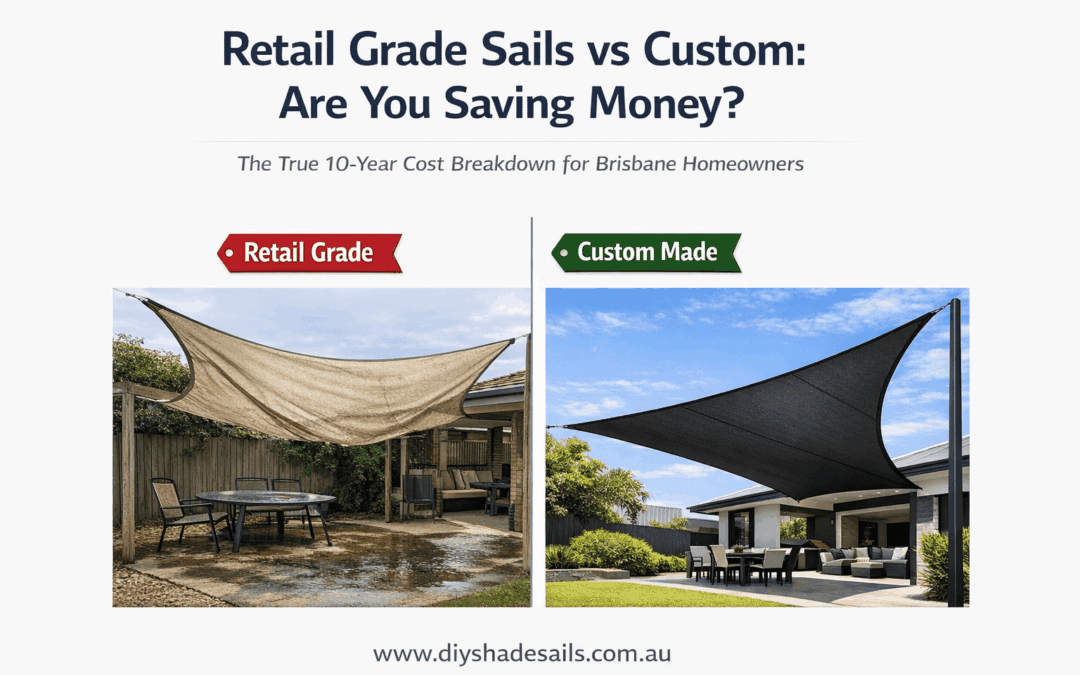
You might buy a retail grade sail for $350 to $450, put it up over the weekend, and be happy with how it looks. But after two summers, the fabric starts to sag and the corners pull. One good storm can shift everything, and the tension disappears. Soon, you’re back at the hardware store, spending more money.
That cycle is more common than most people realise — and it’s the real reason the conversation about shade sail pricing deserves a closer look.
Why Retail Grade Shade Sails Are So Popular
It’s easy to see why people like them. Retail grade sails are ready to buy, don’t need to be ordered in advance, and usually cost less at first. With standard sizes, you can pick one up, follow a simple guide, and have shade by the afternoon.
For many buyers, that simplicity is appealing, and it makes sense if you only need shade for a short time or your space matches a standard size. But most outdoor areas don’t fit standard dimensions, and a shade sail isn’t just a seasonal item. It’s a permanent outdoor feature that needs to handle wind, sun, and storms year after year.
The Hidden Costs of Retail Grade Sails
The price you pay at first is only part of the story. The real cost comes when a retail grade sail doesn’t fit well, loses tension, or wears out quickly.
Fixed Sizes Rarely Fit Perfectly
Standard retail shapes, like squares, rectangles, and equilateral triangles, are made for average spaces, not your unique area. If your fixing points don’t match the sail’s corners, the tension is off right away. This uneven tension puts extra stress on the fabric, causing sagging, edge problems, and poor drainage. This is even more important with waterproof shade sails. If the sail isn’t tensioned properly, water will pool instead of running off, which adds weight and wears out the fabric faster.
Installing a shade sail correctly begins with precise measurements, and that’s difficult to achieve when your sail was built for someone else’s space.
Webbing Edges vs. 316 Stainless Steel Cable
This is where you really see the difference between retail-grade and commercial-grade sails. Many retail sails use webbing straps, cloth edges, or rope around the edges. These materials can’t be pulled tight enough. When the wind blows, the fabric stretches along the edges because there’s nothing strong to hold its shape.
A well-made sail uses a 316 stainless steel cable around the edge. The cable runs through the hem and is attached to 316 stainless steel turnbuckles, D-rings, and D-shackles. This setup lets you stretch the fabric to the right tension without putting all the strain on the edge material. The sail keeps its shape under stress instead of bending out of shape.
Shorter Lifespan in Brisbane Conditions
Brisbane’s climate is tough on shade products that aren’t built well. Strong UV rays break down fabric faster than in cooler places, summer storms bring heavy winds, and the long outdoor season means the sail is under stress for more months each year than in southern states. A retail grade sail put up in Brisbane in autumn might still look okay by Christmas, but by next March, it can show clear signs of wear. When the fabric wears out, threads break, corners tear, and you often need a replacement within two to three years.
Why Custom-Made Shade Sails Deliver Better ROI
Built to Exact Measurements
A custom shade sail is designed to fit your exact fixing points. Whether you need 3, 4, 5, or 6 points for shapes like triangles, rectangles, pentagons, or hexagons, the sail is planned using special CAD software to get the geometry right before any fabric is cut. This way, the load is spread evenly, the tension lines are correct, and the fabric fits your space perfectly.
Commercial Grade Fabric Matters
The standard commercial-grade fabric is a heavy-duty 235 gsm HDPE shadecloth — heat-set for stability — offering 94–97% UVA protection and up to 99% UVB protection (average 95%). For areas that require wet-weather coverage, the waterproof shade fabric option uses Comshade 95 — a 300gsm HDPE fabric with a stented laminate backing.
This is a meaningful step up in weight and weather resistance, and because waterproof shade sails must shed water rather than absorb it, correct tension geometry is non-negotiable. A custom build ensures the geometry is right from the start.
10-Year Warranty Reflects Long-Term Confidence
The length of the warranty shows how much the manufacturer trusts their product. Every sail comes with a 10-year pro-rata manufacturer’s warranty, and you can upgrade to a 15-year stitching warranty with PTFE thread. Skilled machinists use computer-assisted double-needle lockstitch machines, and all corners are double-reinforced. These quality controls come from over 30 years of commercial manufacturing and more than 25,000 sails made at one Brisbane factory.
Real Cost Comparison Over 10 Years
When you account for replacement cycles, the economics shift considerably.
| Cost Factor | Retail Grade Sail | Custom Shade Sails |
|---|---|---|
| Upfront cost | ~$350–$450 | ~$850–$1,200 |
| Expected lifespan | 2–3 years (Brisbane conditions) | 10+ years |
| Replacements over 10 years | 3–4 units | 0–1 units |
| Estimated 10-year spend | $1,200–$1,600+ | $850–$1,200 |
| Warranty coverage | Minimal or none | 10-year pro-rata; optional 15-year stitching |
The cheapest option at first often ends up costing the most in the long run. When you add up your time for three reinstallations, the cost of new hardware, and the hassle of a sail that doesn’t work well, the difference becomes even bigger.
When a Retail Grade Sail Might Be Enough
A retail grade sail is a reasonable choice in specific situations:
- Temporary shade for an event or short-term setup
- Short-term rental properties where a basic level of coverage is all that’s needed
- Sheltered, low-wind locations where structural load is minimal
- Trial installations before committing to a permanent custom design
Where retail grade consistently underperforms:
- Permanent outdoor living areas and alfresco spaces
- Any waterproof shade sail installation (pooling water on an improperly tensioned waterproof sail can cause hardware strain and edge failure)
- Commercial spaces and high-traffic areas
- High-wind and exposed locations, which are much of Greater Brisbane and southeast Queensland
The Smarter Investment for Brisbane Outdoor Spaces
Brisbane’s strong sun, summer storms, and long outdoor season put real stress on shade sails. A sail that looks good in a showroom faces much tougher conditions once it’s installed and the wind picks up. Making sure the geometry, cable, and fabric are right from the start is what makes a sail last ten years instead of ending up in the bin after three.
A properly engineered, custom shade sail — built to your exact fixing points, with a 316 stainless steel cable perimeter and commercial-grade fabric — is designed to last, not just survive the first season. If you’re ready to see what your specific space would cost, the online shade sail price calculator lets you enter your fabric type, number of fixing points, and perimeter measurements for an instant quote with no commitment required.