
Imagine stepping out onto your Brisbane deck and enjoying the comfort of a newly installed shade sail overhead. It looks great. Then the first big summer storm rolls through and you wake up to find the sail stretched out of shape, holding a pool of water in the middle, or dangling from one post.
This is not just bad luck. In most cases, it comes down to one thing: how the edges of the sail were built.
Most buyers compare fabric colour and price when shopping for a shade sail. But the real difference, the one that determines whether your sail stays drum tight for fifteen years or starts sagging within a season, often comes down to edge construction. Specifically, whether the sail uses a stainless steel cable edge or a webbing strap edge.
This guide explains what each system is, how they compare in real-world Australian conditions, and which one is right for your project.
What Is a Stainless Steel Cable Edge Shade Sail?
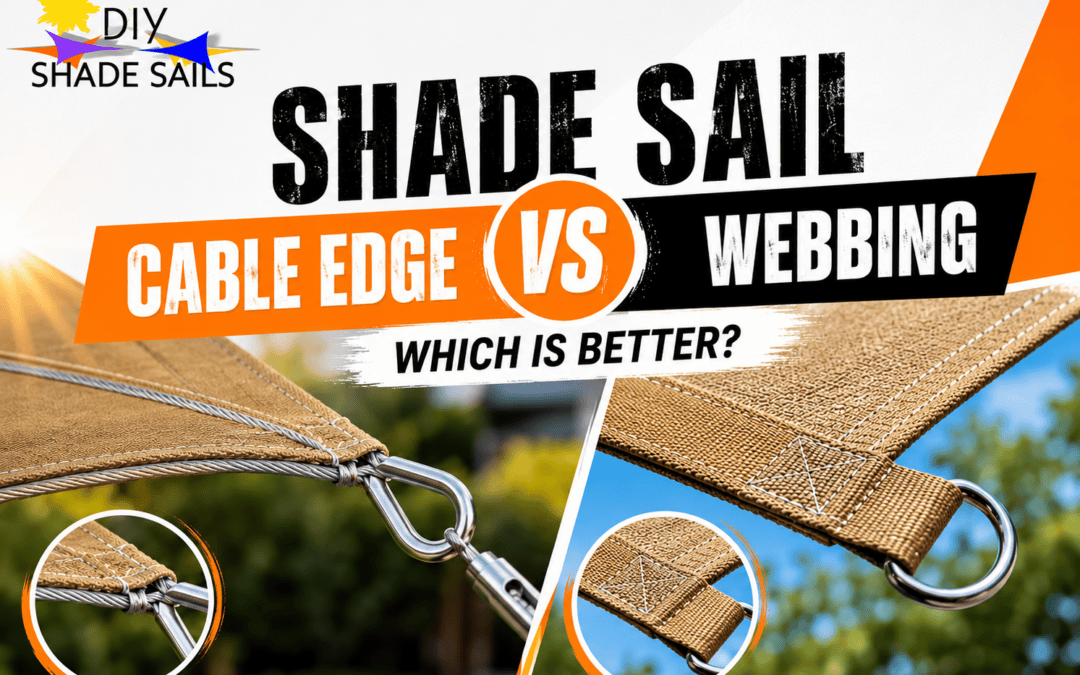
A stainless steel cable edge shade sail features a high-strength 316 marine-grade stainless steel cable that runs continuously through a reinforced sleeve sewn around the entire perimeter. This integrated cable system provides exceptional strength, improves tension, and helps the sail maintain its shape over time. This cable forms the structural backbone of the whole structure.
Here is what makes it different:
- The cable moves independently of the fabric. It does not stretch with the shade cloth. When you tension the corners using turnbuckles, the cable pulls the edges outward and transfers the structural load directly to the posts rather than through the fabric and its stitching.
- It allows the sail to be tensioned drum tight. Because the steel cable handles the load, you can pull the sail to a very high and even tension without putting excessive stress on the cloth itself.
- The fabric sits within the cable frame. Wind and rain forces pass over or through the sail rather than getting caught in it.
The corners of a well-built cable-edge sail also include multiple layers of reinforcement: heavy seatbelt webbing gussets, extra fabric layers, and heavy-duty D-rings where the swaged cable terminates. The result is a sail that can handle the structural loads of a permanent outdoor installation in Queensland weather.
Not all stainless steel is equal. 316-grade contains molybdenum, which gives it far better resistance to saltwater, humidity, and the UV-accelerated corrosion common in subtropical Australian environments. At DIY Shade Sails, every custom-made shade sail comes with a 316 stainless steel perimeter cable as standard. It is the same grade used in marine hardware because it genuinely holds up long-term.
What Is a Webbing Edge Shade Sail?
A webbing edge shade sail uses UV-stabilised, seatbelt-style webbing sewn directly into the fabric hem along the perimeter. The webbing and the fabric are bonded together and stretch as one unit.
Tension in a webbing-edge sail relies on the calculated stretch of the webbing matching the stretch of the shade cloth. This makes them simpler and faster to produce, and they fold flat for easy storage.
Webbing-edge sails are common in:
- Mass-produced, lower-cost shade sails from hardware and discount stores
- Smaller sails intended for temporary or seasonal use
- Four-corner regular-shaped sails where factory measurements are accurate
The key limitation is that webbing has an elastic limit. Under constant tension and UV exposure, it stretches over time. This makes webbing-edge sails difficult to maintain at the same sustained tension level as a cable-edge sail, and that gap widens every year they are installed.
Shade Sail Cable Edge vs Webbing: The Key Differences
Here is a direct comparison across the factors that matter most for Australian installations:
| Feature | 316 Stainless Steel Cable Edge | Webbing Strap Edge |
|---|---|---|
| Tension Capability | Extreme, drum tight under full load | Moderate, limited by webbing stretch |
| Storm Resistance | Superior, deflects wind load smoothly | Low to moderate, prone to flutter |
| Rain and Ponding | Excellent, Hypar shape sheds water immediately | Poor, can sag and collect water |
| Shape Retention | Holds shape for 10 to 15+ years | Can lose shape within 3 to 5 years |
| Overall Lifespan | 10 to 15+ years | 3 to 5 years |
| UV Durability | 316 steel is unaffected by UV | Webbing stitching degrades under UV |
| Adjustability | Fully adjustable via turnbuckles | Fixed, calibrated at factory |
| Installation | Requires careful sequential tensioning | Simple hook-and-tension process |
| Measurement Tolerance | Forgiving, cable compensates minor post errors | Needs precise measurements |
| Best For | Pools, carports, schools, permanent installations | Small temporary or seasonal sails |
The table above shows the performance gap clearly. For permanent outdoor shade in Queensland, that difference is significant. It can determine whether your shade sail withstands years of harsh weather and repeated storms or begins to sag, stretch, or fail long before its expected lifespan.replacing within a few seasons.
Why Does One Shade Sail Quote Cost More Than Another?
This is one of the most common questions from buyers comparing supplier quotes. The price difference between two shade sails of a similar size often comes down to what is inside the construction rather than what you can see from the outside.
Here are the main factors that drive the price gap:
- Edge system: A cable-edge sail uses a 316 stainless steel shade sail cable and precision-sewn perimeter sleeves. A webbing-edge sail uses sewn fabric webbing. The materials and manufacturing time differ significantly.
- Hardware grade: Quality sails use 316 stainless steel turnbuckles, shackles, and D-rings. Cheaper alternatives often use 304-grade or plated fittings that corrode faster in Queensland conditions.
- Fabric quality: Commercial-grade HDPE shade cloth with proper UV stabilisation costs more than thin, lower-density fabric used in discount sails.
- Engineering: A properly made shade sail is cut and sewn using tension membrane CAD software, which calculates the exact geometry for the sail to pull correctly under load. Generic one-size options skip this step.
- Stitching and construction: Industrial machinists using commercial-grade sewing equipment produce a structurally sound seam. Lower-cost sails are often sewn faster on lighter machinery.
- Local manufacturing: An Australian-made sail from a local factory carries a different cost structure than a mass-imported product, but it also comes with accurate sizing, real after-sales support, and the ability to make sails to your exact measurements.
The honest answer is that a quality cable-edge shade sail costs more upfront because it is built to last. A cheap webbing-edge sail from a hardware store may look the same on day one, but the performance gap becomes obvious once the first storm season hits.
Why Cheap Hardware Store Shade Sails Often Fail
Walk into any large hardware chain or browse a discount online store and you will find shade sails at a fraction of the price of a custom-made alternative. They come in set sizes, fold into a small bag, and look appealing on the shelf.
Here is what you are usually getting:
- Webbing edges with no cable. These sails rely entirely on the fabric and webbing to hold their shape. They can be tensioned when new, but they will stretch and sag as the webbing relaxes under load and UV exposure.
- Lower-density fabric. Budget shade cloth is often thinner and less robust than commercial grade shade sail fabric, which can impact both UV protection and long-term durability. In Queensland’s high-UV environment, lower-quality fabrics tend to degrade faster, potentially shortening the lifespan of the shade sail and increasing maintenance or replacement costs over time.
- Generic sizing. These sails are cut to standard dimensions, not your actual anchor-point measurements. A sail that is even 10 to 15 centimetres off in any direction will either sit too slack or pull unevenly on your fixings.
- Lower-grade hardware. Plated or 304-grade fittings are common in cheaper kits. In Brisbane’s humidity and coastal salt air, these show rust within a year or two.
- No engineering input. The sail geometry is not calculated for your specific anchor points or for the Hypar twist needed to shed Queensland’s heavy rainfall effectively.
The failure pattern is consistent: the sail looks fine for the first summer, starts to sag by summer two, and by summer three the stitching has started to go from the constant flutter and UV stress. For a shaded area you plan to keep, you end up spending more replacing cheap sails than you would have spent on one quality custom sail.
Why Does My Shade Sail Sag?
This is one of the most searched questions in the shade sail category, and the answer almost always traces back to edge construction and tensioning.
These are the most common causes:
- Webbing stretch: Webbing has natural give. Under constant load and heat, it elongates. Once it passes its elastic limit, it will not return to its original shape.
- Fabric creep: Shade cloth can relax over time, particularly in cheaper grades. When there is no rigid cable in the perimeter to hold the shape, both the fabric and edging stretch together.
- Water ponding: When a sail loses tension and develops a low point, rainwater collects. A pooled sail can hold considerable weight, which accelerates sagging and can tear stitching or overwhelm the corner hardware.
- Under-tensioning at installation: Not pulling the sail tight enough during setup or failing to re-tension after the initial stretch period allows the sail to go slack sooner.
- Measurement errors: Webbing-edge sails are calibrated at the factory for specific anchor-point distances. Small errors cause the sail to fit too loosely or pull unevenly.
- Low-quality hardware: Undersized turnbuckles, weak shackles, and rust-prone fittings all contribute to ongoing sag.
Signs Your Shade Sail Is Losing Tension
-
- Visible sag or belly in the middle of the sail
- Water collecting after rain
- Edges that ripple or flutter in light winds
- Visible wrinkles running from corner to corner
- Turnbuckles fully extended with no adjustment remaining
A cable-edge sail addresses most of these issues. The steel perimeter maintains the structural shape, turnbuckles allow for re-tensioning as needed, and the Hypar geometry actively channels water away from the centre of the sail.
What Does “Drum Tight” Actually Mean?
You will hear this phrase from professional shade sail installers and manufacturers. It is not marketing language. It describes a specific performance standard.
Drum tight means the sail surface is under even, consistent tension across its entire span. When you press the centre of a properly tensioned cable-edge sail, it should feel very firm with minimal give. The surface should look smooth and flat, like a stretched canvas, rather than slack or rippled.
Here is why it matters in practice:
- Reduced flutter: A taut sail does not move in the wind. Flutter is the repeated flapping of a loose sail edge and it is one of the main causes of premature fabric and stitch failure.
- Better storm performance: A drum-tight sail deflects wind load smoothly. A loose sail catches wind like a parachute and creates cyclic upward and downward forces that can pull posts or anchors out of the ground.
- No water ponding: Even tension combined with a Hypar design means rainwater runs off immediately rather than collecting in a sagging centre.
- Better appearance: A taut sail looks clean and intentional. A saggy sail looks neglected, regardless of how good the fabric was originally.
Achieving drum-tight tension consistently over many years requires a cable-edge construction. Webbing simply cannot sustain that level of load without gradually stretching.
Why Brisbane Conditions Favour Cable Edge Shade Sails
Brisbane and South East Queensland are among the more demanding environments for outdoor shade structures in Australia. The climate creates a specific set of problems that cheaper shade sail construction handles poorly.
High UV Exposure
Brisbane receives some of the highest UV radiation levels of any major Australian city. UV degrades materials steadily, including the UV-stabilised coatings on webbing, the thread used in stitching, and the connecting hardware. A cable-edge sail reduces the strain on the fabric by transferring structural loads through the steel wire, which UV radiation does not affect.
Sudden Summer Storms
Brisbane is well known for its afternoon summer supercells sudden, severe thunderstorms with strong wind gusts that arrive with very little warning. A loose, webbing-edged sail in these conditions acts like a sail on a boat. It acts like a giant sail in strong winds, placing substantial stress on the supporting posts and anchor points. Over time, these forces can damage the structure the shade sail is attached to if it is not properly designed and installed. A cable-edge sail stays rigid under load and allows the wind to pass over and through the structure rather than lifting it.
Heavy Rainfall and Water Ponding
Brisbane regularly sees intense rainfall. A shade sail that sags even slightly will collect rainwater at its lowest point. The weight of pooled water accelerates structural failure significantly. A fully tensioned cable-edge sail combined with a Hypar design sheds water immediately and reliably.
The Hypar Design Advantage
The best-performing shade sails in Queensland use a Hyperbolic Paraboloid (Hypar) shape two diagonal corners set high and two set low, creating a gentle twist across the sail surface. This geometry does two things:
- It sheds rainwater efficiently, water always has a clear path to run off rather than pooling in the centre.
- It creates structural rigidity, the curved geometry locks the sail into shape in the same way a curved roof panel is stiffer than a flat one.
Achieving a true Hypar shape requires the perimeter to handle multi-directional tension loads simultaneously. This is where cable-edge construction becomes essential. The steel cable manages the complex, competing forces at each corner and along each edge, keeping the sail smooth and wrinkle-free. Webbing-edge sails typically cannot sustain the same level of tension across a twisted geometry.
Is 316 Marine-Grade Stainless Steel Necessary?
For outdoor installations in Queensland, the answer is yes.
There are two grades of stainless steel commonly used in outdoor hardware:
- 304 stainless steel: The standard grade. Good general corrosion resistance for dry inland environments with low humidity.
- 316 stainless steel: Contains molybdenum, giving it superior resistance to corrosion and rust, making it an excellent choice for harsh outdoor and coastal environments. As a result, it performs more reliably in coastal areas, humid climates, and locations exposed to frequent rain or salt air, helping extend the lifespan of outdoor hardware and fittings.
For shade sails in Brisbane and across Queensland, a humid, subtropical climate, 316 stainless steel is the appropriate specification for all hardware: the perimeter cable, turnbuckles, shackles, and eye bolts. Using 304-grade hardware outdoors in Queensland leads to rust staining on walls and posts, and eventual hardware failure as corrosion weakens the fittings over time.
Stainless steel hardware is prone to galling, a form of cold welding where the threads seize under friction during tensioning. Always lubricate stainless steel turnbuckle threads with graphite-based anti-seize compound, lanolin, or a suitable grease before tensioning. This small step prevents threads from locking up and makes re-tensioning over the sail’s life much easier.
Which Edge System Is Best for Permanent Shade Sails?
Here is a clear, practical recommendation based on installation type:
Webbing May Be Suitable For:
- Small sails under 4 to 5 metres that will be removed seasonally
- Temporary shade solutions where budget is the main constraint
- Sails that will be stored for part of the year and re-hung when needed
- Regular square or rectangular shapes with accurate factory measurements
Cable Edge Is the Better Choice For:
- Pool areas and outdoor entertaining spaces
- Carports and permanent vehicle shelter
- Schools, childcare centres, and public spaces
- Commercial properties needing durable, long-lasting shade structures
- Any installation that will remain up year-round in Queensland
- Larger spans or irregular shapes requiring a Hypar geometry
- Situations where re-tensioning over time is expected
The performance gap between the two systems grows with time and in more demanding conditions. For a sail that will be in place for ten years or more, the extra investment in cable-edge construction pays for itself in avoided replacements and reduced maintenance.
At DIY Shade Sails (a division of Brisbane Sailmakers Pty Ltd), every custom-made shade sail is manufactured with a 316 stainless steel perimeter cable as standard, not as an optional upgrade. The company has been building to this standard since 1994 and has produced over 25,000 shade sails delivered across Australia. Each sail is engineered using tension membrane CAD software and sewn by experienced machinists using industrial-grade equipment.
Cable Edge vs Webbing: Final Verdict
Not sure which option suits your situation? Here is the short version:
| If you need… | Choose this edge system |
|---|---|
| Temporary shade | Webbing |
| Budget solution | Webbing |
| Pool shade | Cable Edge (316 Stainless Steel) |
| Carport shade | Cable Edge (316 Stainless Steel) |
| Commercial shade | Cable Edge (316 Stainless Steel) |
| Brisbane storm resistance | Cable Edge (316 Stainless Steel) |
| Long-term value | Cable Edge (316 Stainless Steel) |
| School or childcare | Cable Edge (316 Stainless Steel) |
Frequently Asked Questions
Can a webbing-edged shade sail be tensioned properly?
What does drum tight mean for a shade sail?
Why is stainless steel cable used instead of rope?
Is 316 marine-grade stainless steel necessary for shade sails?
What is the best edge for shade sails?
How long does a cable-edge shade sail last?
Do all custom shade sails use cable edges?
Can a sagging shade sail be tightened?
Are cable-edge shade sails harder to install?
The Bottom Line
When you are comparing shade sail quotes and wondering why the prices vary, edge construction is often the most important factor that nobody tells you about upfront.
A webbing-edge sail can work well for small, temporary, or seasonal applications. But for any permanent shade structure in Brisbane or Queensland, a pool area, carport, outdoor entertaining space, school, or childcare centre, a 316 stainless steel cable edge is not a premium upgrade. It is the correct way to build a shade sail that will hold up.
The difference between a sail that stays drum tight for fifteen years and one that sags within a season comes down to whether there is a steel cable running the perimeter, or whether the fabric and webbing are being asked to carry that load alone.
If you are ready to get a quote on a custom shade sail built to the correct specification for Queensland conditions, DIY Shade Sails manufactures every sail with 316 stainless steel cable edge construction as standard, delivered factory-direct, Australia-wide.