
Short Summary
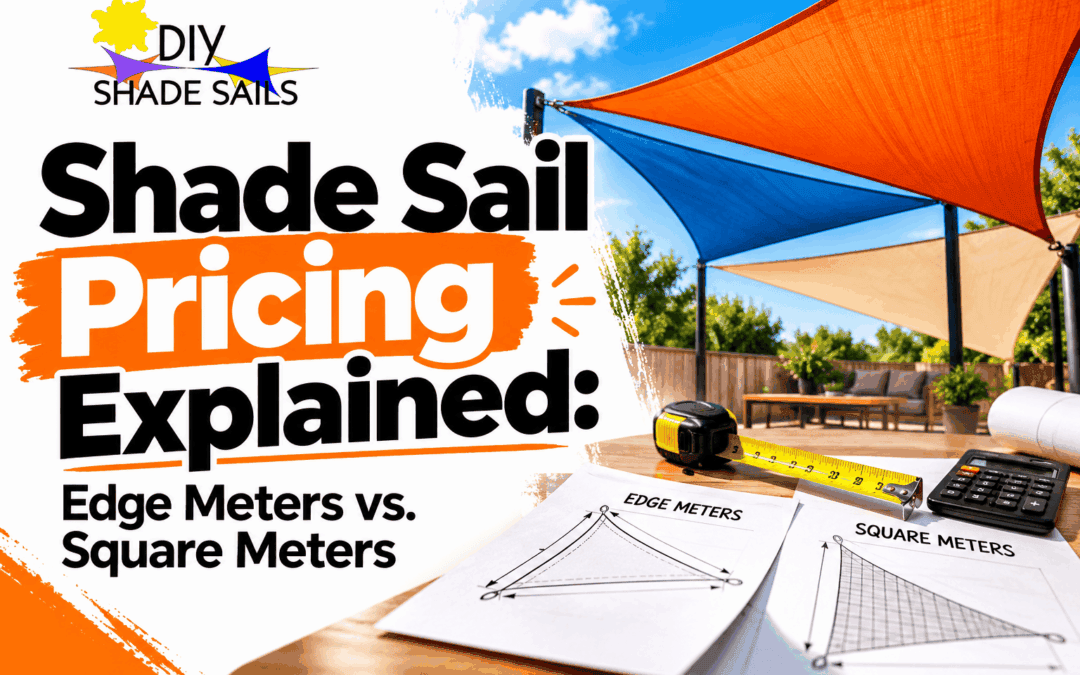
Shade sail pricing can be confusing, especially when comparing edge meters and square meters. Edge meters measure the total perimeter of the sail and are often used for custom sails because the edges require cutting, reinforcement, stitching and perimeter cable. Square meters, on the other hand, measure the area the sail covers.
To estimate your shade sail cost accurately, measure each edge between the fixing points and add them together. Keep in mind that the final price can also depend on the number of fixing points, fabric, sail shape, hardware, posts, installation and site requirements. Always compare what is included in each quote rather than looking at the price per meter alone.
In shade sail pricing, edge meters measure the total length around a sail, while square meters measure the area it covers. Custom sails are often priced by edge meter because the perimeter is where most of the manufacturing happens: cutting, reinforcing, stitching and fitting the cable that lets the sail be tensioned.
So when you price a custom sail, you’re paying mostly for the perimeter, cable, hems and hardware, not the patch of ground underneath.
Shade sail pricing in simple terms
- Square meters = how much area the sail covers.
- Edge meters = how much perimeter needs to be manufactured.
- Fixing points = where the sail attaches, such as posts or wall brackets.
- Fabric = affects the material cost.
- Hardware = components such as turnbuckles and shackles.
- Installation = a separate project cost, where it applies.
What Is an Edge Meter on a Shade Sail?
An edge meter is one meter of a shade sail’s perimeter. To calculate the total edge meters, add the length of every edge between the fixing points.
A fixing point is the spot where a corner of the sail attaches, such as a post, wall bracket or roof beam. Every sail has one edge between each pair of neighbouring fixing points.
Why Are Shade Sails Priced by Edge Metre?
So how are shade sails priced at DIY Shade Sails Australia? Custom sails are priced by edge meter because the perimeter closely reflects the work involved. The middle of a sail is plain fabric. The edges and corners are where the sail is shaped, strengthened and connected to its fixing points.
We design each custom sail with tension-membrane CAD software, which plans fabric that holds its shape when pulled tight. Along every edge:
- Fabric and finishing. Each edge is cut, reinforced, hemmed and stitched on heavy-duty industrial machines.
- Perimeter cable. Our custom sails use 316 marine-grade stainless steel cable around the edge instead of rope or webbing. The cable spreads tension around the sail so it can be tensioned correctly.
- Corners. Corners carry the load to your posts or building, so complex layouts can need more design work.
- Shape. Three, four, five and six-sided or irregular sails all have different perimeters.
Why Square Meters Don’t Tell the Whole Pricing Story
Square meters tell you how much shade you’ll get, but they say little about how much perimeter has to be built. Two sails can cover the same area and still need very different amounts of edge work.
Two Shade Sails With the Same Area Can Have Different Prices
These are illustrative examples only, not real quotes.
- Sail A: a compact 5 m by 5 m layout covers 25 square meters and has 20 edge meters .
- Sail B: a narrow 10 m by 2.5 m layout also covers 25 square meters but has 25 edge meters.
Sail B has 5 more meters of edge to cut, hem, stitch and fit with cable, yet a shade sail cost per square meter would treat both as the same job. With shade sail pricing, edge meters capture that extra work.
How to Measure Your Shade Sail’s Edge meters
Measure the distance between the fixing points rather than trying to measure the finished fabric. The sail is manufactured with the allowance it needs for tensioning, so the fixing-point measurements are what you enter in the calculator.
- Identify each fixing point where a corner will attach.
- Measure from one fixing point to the next, working around the shape in order.
- Write down every edge length as you go.
- Add the lengths together to get your total edge meters.
- Enter the total in the matching price calculator.
Don’t add extra length for turnbuckles or other hardware. Our calculator instructions specifically say not to make that allowance. For tips on accuracy, see our step-by-step guide on how to measure a shade sail.
What Affects Shade Sail Cost?
In shade sail pricing, edge meters are a big part of the price, but they’re not the only part. The cost of a custom shade sail and its installation depends on:
- Total edge meters
- Number of fixing points
- Fabric type
- Sail shape
- Perimeter construction, such as cable or webbing
- Hardware
- Posts and footings
- Installation
- Site access
- Engineering requirements
For Brisbane homes, wind exposure, strong UV, heavy rain and the strength of your roof or walls can also shape these costs. A shade sail is a tensioned structure, so its performance depends on the sail, hardware, fixing points, installation and site together.
What Should a Shade Sail Quote Include?
A clear shade sail quote should list everything above that applies to your job. When comparing suppliers, check that each quote states:
- total edge meters and number of fixing points
- fabric type and specification
- how the perimeter is built
- hardware, including turnbuckles and shackles
- posts, footings, installation and freight
- engineering and site costs, where required
If one quote is much lower, the gap is often in what’s left out rather than the measurement used. Our guide to the full cost of a shade sail project covers the costs beyond the sail itself.
Is Pricing by Square Metre Wrong?
No. Square-meter pricing can be a perfectly valid way to quote a shade sail. When comparing shade sail pricing, edge meters and square meters are simply two different ways of measuring the job. Pricing methods vary between suppliers, and the important question is what the quoted price includes.
The pricing method alone also doesn’t tell you which quote is cheaper. If someone quotes per square meter, ask: “What exactly does your square meter price include?” Then check whether it covers perimeter reinforcement, cable, corner hardware, posts and installation, and whether it’s based on the finished sail or the covered area.
A price per square metre, or any shade sail price per metre, is only useful when you know what is included in that price.
How to Use a Shade Sail Price Calculator
Once you know your total edge meters and number of fixing points, you can use the relevant shade sail price calculator to estimate the cost of your custom sail. Each calculator then asks for your edge lengths and fabric choice:
- Three corners? Use the 3-point shade sail price calculator.
- Four corners? Use the 4-point shade sail price calculator.
- Five corners? Use the 5-point shade sail price calculator.
- Six corners? Use the 6-point shade sail price calculator.
Happy with your price? Order through the standard fabric shade sail order form, or the waterproof shade sail order form if you want rain protection too. We deliver Australia-wide.