
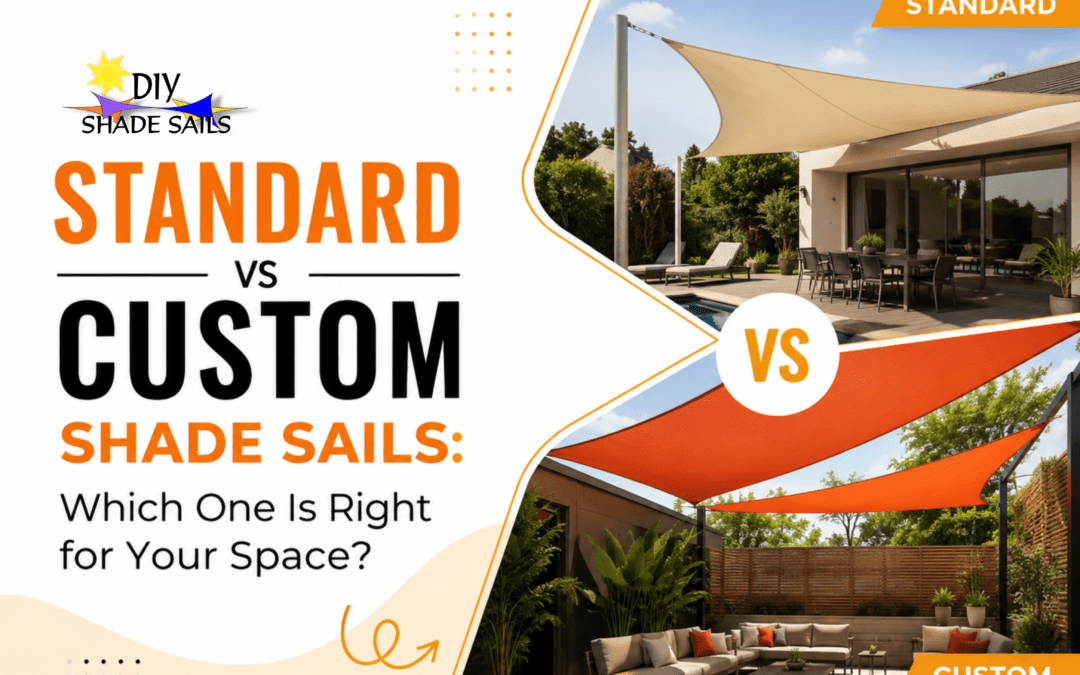
Choosing between a standard vs custom shade sail is one of the first decisions any Australian homeowner faces when planning outdoor shade. The right choice depends on your space, your budget, and how long you want the sail to last.
Australia’s climate makes this decision more important than it might seem. Strong UV exposure, sudden wind gusts, and seasonal storms all put pressure on a shade sail’s fabric and fixings. A poorly fitted or improperly tensioned sail is more prone to flapping, sagging, and premature wear.
Standard shape shade sails are ready-made, come in set sizes, and are usually the quicker, more affordable option. Custom shade sails are built to your exact measurements and fixing points, giving a precise fit for spaces that don’t suit an off the shelf shade sail.
This guide compares both options across cost, fit, installation, durability, and appearance, so you can work out which one suits your backyard, patio, or driveway.
Quick Answer
For regular spaces and tighter budgets, a standard shade sail is often sufficient. For irregular layouts or maximum coverage, a custom shade sail generally delivers better long-term value.
What Is a Standard Shape Shade Sail?
An off the shelf shade sail can be a practical solution when your outdoor space matches common dimensions, since there’s no waiting for a custom design process. Because they’re produced in batches ahead of time, they’re typically ready to ship as soon as you order, which makes them a popular choice for straightforward installations.
Standard shape shade sail sizes are usually based on common backyard dimensions, and the most widely available shapes are:
- Triangle – suited to corner spaces and smaller areas
- Square – a balanced option for patios and courtyards
- Rectangle – useful for longer spaces like driveways or decks
Because the shapes and sizes are fixed, standard sails work best when your fixing points already line up with a common configuration. Browse Standard Shape Shade Sails to see the common sizes available — if your posts, fence line, or wall brackets already match a standard size, this option can give you a good result without extra design work.
Standard sails are generally the more budget-friendly choice upfront, since there’s no custom design or made-to-order manufacturing involved. They suit straightforward rectangular or square spaces, simple backyard corners, and situations where you need shade sorted quickly.
The trade-off is flexibility. If your area has an irregular shape, a slope, or unusually positioned fixing points, a standard shade sail may not fit properly, resulting in gaps, awkward overhangs, or the need for additional hardware. If that happens, our Shade Sail Hardware range includes turnbuckles and shackles that can help bridge small gaps between your fixing points and a standard size.
What Is a Custom Shade Sail?
A custom shade sail is made to measure, designed around your specific fixing points rather than a generic size. Instead of choosing from a fixed range, you provide your measurements and the manufacturer builds the sail to suit your exact space.
This process typically starts with measuring the distances between fixing points, along with their heights and angles. Our Shade Sail Measurement Guide walks through this step by step. Manufacturers then use tension-membrane-specific CAD software to design a sail shape that distributes tension evenly across all corners. This step matters because shade sails rely on tension, not just size, to perform well in wind and resist pooling water.
A made to measure shade sail Australia-wide is built for the conditions of your specific block, whether that’s a tight courtyard, a sloped backyard, or a driveway with posts at uneven heights. Custom sails are designed using tension-membrane CAD software and manufactured in Brisbane using commercial-grade materials, with industrial sewing equipment used to build each sail to order before it’s delivered Australia-wide.
To understand the process in more depth, see What Are Custom DIY Shade Sails. Custom sails suit:
- Irregular or unusually shaped spaces
- Areas with existing fixing points that don’t align with standard sizes
- Multi-point configurations (5 or 6 points instead of the typical 3 or 4)
- Larger areas where precise coverage reduces wasted shadecloth
Because the sail is designed around your space rather than the other way around, custom shade sails generally offer tighter coverage with fewer gaps at the edges.
Standard vs Custom Shade Sail Comparison
Here’s a side-by-side look at how the two options compare across the factors that matter most.
Standard vs Custom Shade Sail: What’s the Difference?
A standard shade sail is a pre-made sail available in fixed shapes and sizes, while a custom shade sail is manufactured to suit specific measurements and fixing points. Standard sails are usually more affordable, while custom sails offer a more precise fit and better coverage.
| Feature | Standard Shape Shade Sail | Custom Shade Sail |
|---|---|---|
| Cost | Lower upfront cost | Higher upfront cost, better long-term value |
| Installation | Quick, minimal planning needed | Requires accurate measuring before manufacture |
| Fit | Fixed sizes; best for regular spaces | Built to exact fixing points and dimensions |
| Appearance | Good, but may leave gaps in irregular spaces | Tailored coverage with a tighter, neater finish |
| Coverage | Limited to standard shapes | Maximised for the specific space |
| Durability | Good when properly tensioned | Often higher, due to design built around even tension |
| Lead Time | Fast, typically ready to dispatch | Longer, as each sail is made to order |
| Long-Term Value | Strong for budget-conscious, regular spaces | Strong for irregular spaces or long-term use |
Which Option Fits Better?
Standard Shape Sails
Standard shapes are best suited to regular, rectangular, or square spaces where the existing fixing points already align with common dimensions. If you have a straightforward patio or backyard corner with posts or walls in typical positions, a standard sail can usually be tensioned to fit well without modification.
Custom Sails
Custom sails come into their own when a space doesn’t follow a simple layout. Courtyards with uneven boundaries, large patios with multiple posts, driveways with awkward angles, and multi-level outdoor areas all benefit from a sail designed specifically for that footprint.
Some of the main custom shade sail benefits include better use of available space, reduced fabric wastage, and a finish that follows the natural lines of the area rather than working around them. For homeowners who’ve struggled to find a standard size that fits, custom manufacturing solves the problem at the design stage rather than trying to force a fit on site.
Which Option Lasts Longer?
Durability depends less on whether a sail is standard or custom, and more on how well it’s installed and tensioned.
Shade sail tensioning is one of the most important factors in long-term performance. A sail pulled drum-tight resists flapping in wind and avoids water pooling on the surface, which can stretch the fabric over time. Loose or poorly tensioned sails are more prone to wear, fabric fatigue, and storm damage. Our Shade Sail Installation Guide covers post placement and tensioning technique in more detail.
This is where the perimeter system matters. Sails with a 316 stainless steel cable wired around the perimeter allow for even, adjustable tension across the whole edge, rather than relying on the fabric or stitching alone to bear the load. Stainless steel cable is also corrosion-resistant, which is useful across Australia’s varied climate, from coastal salt exposure to inland heat.
Custom sails are often designed with tensioning in mind from the start, since the CAD design process accounts for the angles and pull direction at each fixing point. Standard sails can achieve similarly strong tensioning, but it depends on how well the fixed shape suits the available points and how carefully it’s installed. Fabric quality and UV resistance matter too, regardless of shape: a well-tensioned, correctly fitted sail of either type will generally outlast a poorly fitted one.
Why Accurate Measurements Matter
Measurement accuracy is one of the most overlooked factors in how well a shade sail performs, regardless of whether it’s standard or custom. Shade sails have been manufactured in Australia using commercial-grade standards since 1994, and across more than 25,000 sails supplied nationwide, the most common fitting issues consistently trace back to measurement, not fabric or design.
Common measurement mistakes include measuring corner-to-corner instead of along the actual fixing line, failing to account for post lean or height differences, and underestimating the sag allowance needed for proper tension. Even a small error at one fixing point can throw off the tension across the whole sail, leading to a looser fit, more flapping in wind, and a shorter usable life.
This is why both standard and custom buyers benefit from measuring fixing points carefully before ordering. For standard sails, accurate measurements confirm whether a fixed size will genuinely fit. For custom shade sails, accurate measurements are the foundation of the CAD design process, helping to prevent delays and costly remakes.
Cost Comparison: Is Custom Worth the Extra Investment?
Standard
Pros:
- Lower upfront cost
- Fast to purchase and install
- No design or measuring lead time
Cons:
- May compromise fit if your space doesn’t match a standard size
- Possible gaps or overhang in irregular layouts
- Limited flexibility for unusual fixing points
Custom
Pros:
- Better coverage with fewer wasted areas
- Improved appearance, since the sail follows the shape of the space
- Designed around your exact fixing points from the outset
Cons:
- Higher upfront cost
- Requires a longer lead time because it is custom made to order.
The cost difference is best thought of as long-term value rather than a premium upsell. A standard sail that doesn’t quite fit may need replacing sooner or require extra hardware to compensate. A custom sail is a larger initial investment, but it’s built once to suit the space properly. For a regular, simple area, a standard sail can deliver excellent value. For an irregular space, custom manufacturing often avoids costs that come from an imperfect fit further down the track.
Typical Australian Use Cases
Backyard Entertaining Areas
Backyard entertaining spaces are often rectangular or square, making them well suited to standard shapes, especially where posts or fence lines are evenly spaced. If the area has an irregular boundary or multiple zones, a custom sail can provide more even shade across the space.
For example, a homeowner covering a standard 4m x 4m patio with four evenly spaced posts may find a standard sail ideal, since it matches a common size without modification.
Patios and Decks
Patios attached to the house frequently have fixing points on the wall, posts, and sometimes a fence. When these points align with a standard rectangle or square, a standard sail is a practical option. Decks with uneven edges or multiple levels tend to benefit more from a custom design.
Driveways and Car Protection
Driveways are usually long and narrow, and fixing points can sit at different heights due to sloped ground or garage structures. This is a common scenario where custom shade sails are preferable, since the design can account for height differences and unusual angles.
A homeowner with a sloped driveway and uneven fixing points will typically benefit from a custom sail, since the CAD design process can compensate for the height difference between posts.
Children’s Play Areas
Play areas are often smaller and more flexible in shape, which means a standard triangle or square can work well, particularly when budget is a priority. For play areas built around garden beds, trees, or existing structures, a custom sail may give more complete coverage without compromise.
Shade Sail Considerations for Darra Homes
Darra and the surrounding western Brisbane suburbs face their own version of Australia’s broader climate challenges, with strong summer heat and the seasonal storms typical of South East Queensland. Brisbane homeowners in this area often deal with similar fixing point challenges, from sloped blocks to established gardens that limit where posts can go.
For backyard entertaining areas, western Brisbane outdoor living often centres on patios and decks used through the hottest months of the year, which makes consistent, gap-free shade coverage worth prioritising. Driveway shade is another common consideration in the area, particularly where carports or garages create uneven fixing heights.
Queensland storm preparation is also worth factoring into the decision. Whichever option you choose, a properly tensioned sail with a well-installed perimeter system will handle sudden wind gusts and storm activity better than one that’s loosely fitted, which is part of why getting the measurements and tensioning right matters as much as the choice between standard and custom.
How to Know Which Shade Sail Is Right for Your Space
Choose Standard If…
Budget is your main priority
Your space is a regular shape, like a square or rectangle
Your existing fixing points align with a standard size
Choose Custom If…
Your space is irregular or has unusual fixing points
Maximum coverage is important
Appearance and a tailored finish matter to you
You’re after long-term value over the lowest upfront cost
If you’re unsure which category your space falls into, taking accurate measurements of your fixing points first will make the decision much clearer. Many Australian outdoor spaces are a mix of both, with one area suited to a standard sail and another needing a custom solution.
Final Thoughts
When it comes to standard vs custom shade sail decisions, there’s no single right answer; it depends on your space and your priorities. A standard shape shade sail is quick to buy, budget-friendly, and well suited to regular spaces with straightforward fixing points. A custom shade sail takes more time to manufacture but delivers a precise fit, better coverage, and strong long-term performance for irregular or larger spaces.
Whichever option suits your home, correct measurements, proper tensioning, and a 316 stainless steel cable perimeter (where applicable) all play a part in how well your sail performs through Queensland’s strong sun and the seasonal storms that affect much of Australia. Taking the time to assess your space properly before buying will help you get a shade sail that fits, performs, and lasts.
Shade sails have been manufactured in Australia using commercial-grade standards since 1994, and the principles haven’t changed much since: accurate measurement, correct tension, and quality materials remain the basis of a sail that performs well over time. Whether you choose a standard or custom option, those fundamentals are worth keeping in mind.